Hello stamp collectors around the world!

I am a young Belgian stamp collector trying to have one nice cover from every country in the world, and I need YOUR HELP to reach this goal! :)

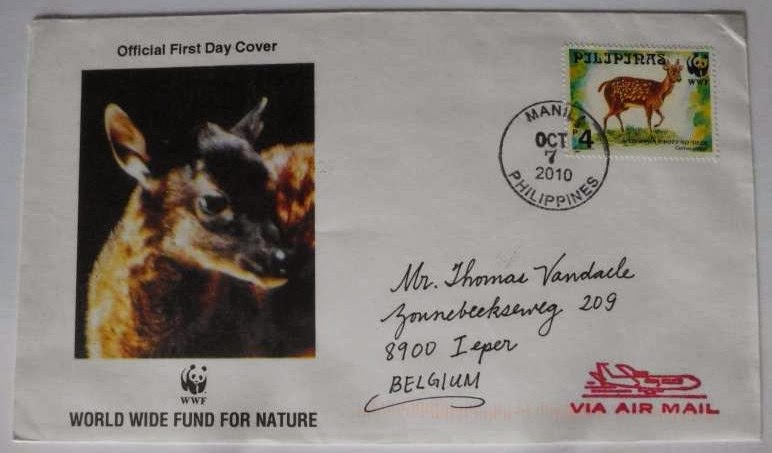
I prefer to have covers franked with WWF stamps, as this is my main (topical) collection. When I already have a cover from your country, please send me only a better cover than the one I already have! WWF covers are always accepted, even when I already have a cover with the same WWF stamps.


Needless to say that I will send you a nice cover from Belgium in return for your help.


CONTACT:

my_stamps@hotmail.com; or

Thomas Vandaele
Zonnebeekseweg 209
BE-8900 IEPER
BELGIUM

05/12/2009

WWF Russia

Many thanks to Vladimir for this wonderful cover from Russia and for the 4 mint WWF stamps inside the envelope!


On the envelope we see 3 stamps from the 2004 WWF serie picturing the wolverine (Gulo gulo), and a label (vignette) with some information about the animal - in Russian so hard to read for me :s :). Thank you Vladimir for this very nice cover!

New WWF cover from Czech Republic

I've been waiting for this cover for a long time, and now I can finally show it on my blog :) Thank you Milan for this wonderful cover from Czech Rep., franked with the 1996 WWF m/s on Czech rodents.

The stamps feature:
  1. 3.60 Kc: Garden dormouse (Eliomys quercinus)
  2. 5.00 Kc: Forest dormouse (Dryomys nitedula)
  3. 6.00 Kc: European Souslik (Spermophilus citellus)
  4. 8.00 Kc: Northern Birch Mouse (Sicista betulina)

Another cover from Slovakia

Thank you Robert for this nice cover about nature preservation. The stamps feature the Fire salamander (Salamandra salamandra) and the European pond terrapin (Emys orbicularis). Both animals are endangered and protected species.


(texts by Ján Kautman, see www.pofis.sk:)

The Fire Salamander is our biggest salamander, measuring up to 20 centimetres in Slovakia and 30 centimetres in Europe. It has a wide head and robust cylindrical body ended by a tail. Its smooth skin has a number of pores through which it can discharge secretions from its poison glands, an action which is suggested by its alerting colour. It has a black body covered with a number of yellow-orange spots of varying size.
The salamanders’ way of life differs significantly from that of other amphibians which live in our country. They are active at night and prefer deciduous, in particular, oak and beech forests on foothills or mountains. Rarely, they can also be found in conifer forests. In Slovakia, they occur at altitudes of up to 1000 metres above sea level.
During the day salamanders like to hide in fallen leafs, under tree trunks or stones, in burrows of other mammals, and various clefts. Their daily activity only increases in the case of strong rain or during courtship. Salamanders usually mate in a dry environment over the autumn, and the following spring the females lay larvae into small brooks, lakes, springs, or wells. The larvae are carnivorous and their maturing period takes more than one year, but usually they metamorphose into young individuals by autumn of the same year. Subsequently, they leave their water habitat and follow the suit of mature individuals. Salamanders move slowly and feed on various invertebrates such as earthworms, molluscs, and other various arthropods.
Salamanders hibernate in deep refuges, often far away from their water habitats.
Fire Salamanders occur throughout Europe, except Scandinavia, the British Isles, and the Mediterranean islands. They can also be found in Turkey and North Africa. The eastern border of their occurrence is delineated by the Carpathian range. A number of geographic subspecies and forms of Salamanders can be found within this area, some of which are regarded as separate species. The Fire Salamander is a protected species throughout Europe, including Slovakia.

The European Pond Turtle is the only original representative of turtles in Slovakia. Like other water turtle species, it has a slightly curved shell. The upper part of the shell (the carapace) is up to 30 centimetres long, and is brown-black with many small whitish or yellow spots. The lower shell (the plastron) is yellow-white to light-brown and has variably dark (usually black) markings. The turtle’s skin on its limbs, tail, neck and the greater part of head is covered by scutes. It has five digits on the front feet, and four digits fused into paddles for swimming with sharp claws on its back feet.
European Pond Turtles usually occur in still water or muddy and overgrown streams in lower altitudes. Their activity begins at the end of March, depending on the climate. During the day they search for food, hide by water areas, and sun themselves on shores or on top of objects floating in water. The turtles can remain submerged for long periods due to their strong breathing apparatus which consists of anal gland and oral cavity mucosa that can absorb oxygen from the water. Turtles usually mate in the water in the early spring, then in late spring or early summer the females lay eggs around ponds into shallow dug holes. In warmer areas the young hatch in autumn. In Slovakia they usually hatch the following year in spring. The young mature at the age of 15 years and live for about 70 years or more. European Pond Turtles are mostly carnivorous, usually feeding on insects, fish, crustaceans, earthworms, and amphibians, sometimes also dead animals, and their diet also includes vegetation. They usually hibernate buried at the bottom of water biotopes from the end of October.
European Pond Turtles are found in Southern and Central Europe, Western Asia, and North Western Africa. Their occurrence in the north extends as far as the Baltics. In Slovakia they only occur within a few isolated areas of the Eastern and Western lowlands.
Throughout Europe, the European Pond Turtle is a strictly protected species. In Slovakia, it is a critically endangered animal which is subject to the highest degree of protection.

Brazil WWF

A new cover from Brazil, courtesy of Flavio. The stamp on the cover pictures the Neotropical Otter, a.k.a. Neotropical River Otter (Lontra longicaudis).


Inside the envelope I found a WWF maxicard for my WWF collection. The card is from the 1984 issue on Muriquis (Brachyteles arachnoides). Thank you Flavio!

29/11/2009

New Belgian stamps (21/09, 5/10 and 3/11/2009)

  1. Rogier Van der Weyden - museum 'M' in Leuven


  2. Art - art on the 'Kunstberg' / 'Mont des Arts' in Brussels


  3. Trees of the 'Zoniën forest' (pine-tree, beech, birch, 'lork' (translation unknown) and oak tree)


  4. 20th anniversary of the comic strip museum


  5. Miniature trains


  6. Canonization of Jozef De Veuster, better known as Father Damien or Saint Damien of Molokai (who looked after the people with leprosy)


  7. This is Belgium - books and writers


  8. Promotion of philately


  9. Europalia China


  10. Christmas 2009

Netherlands

New covers from Sri Lanka

Many thanks to my friend Ravindra for sending me a very nice cover and for helping me with the WWF cover!

The first cover is franked with 6 stamps from a serie on the Polonnaruwa Era:
  1. 5.00: language
  2. 10.00: ethnic and religious unity
  3. 15.00: irrigation civilization
  4. 25.00: architecture
  5. 30.00: health care
  6. 40.00: hindu sculpture


The WWF stamps picture the Ceylonese elephant (Elephas maximus ceylonensis).